

Product Category: Heat Press Machine
Product Sub Category: Heat Press
Product Brand: Glory Tech Laser
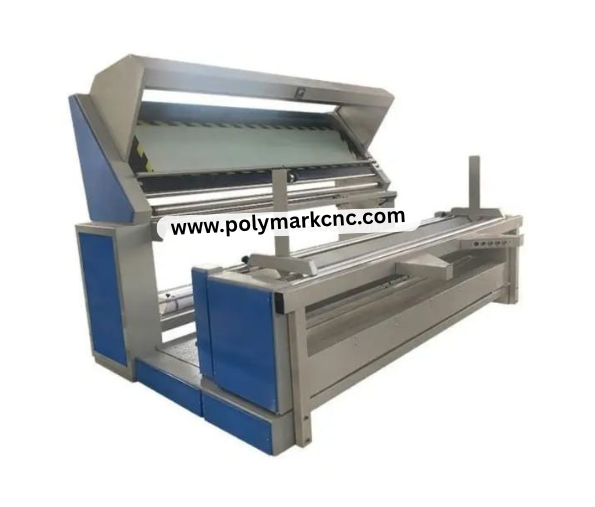
The machine works by unrolling the fabric from a roll and rewinding it on another roll while being monitored by the operator or automated sensors:
Fabric is mounted on the feed roll.
The fabric passes over a roller system at a controlled speed.
Light sources illuminate the fabric evenly.
Operator visually or automatically checks for:
Holes
Snags
Stains
Color variation
Weaving or printing defects
The fabric is rewound on the take-up roll after inspection.
Length measurement is performed simultaneously to verify material quantity.
Automated systems can detect defects using camera systems and software algorithms, highlighting areas for cutting or repair.
Supports large rolls of fabric.
Adjustable for different roll diameters and widths.
Fabric passes over multiple rollers for tension control.
Helps flatten wrinkles for accurate inspection.
Even illumination for defect detection.
LED or fluorescent lamps are commonly used.
Mechanical or electronic counter to track fabric length.
Some models include width measurement.
Digital cameras and sensors for automatic detection.
Can record and mark defects for quality control.
Digital or analog controls for speed, direction, and lighting.
Some machines include memory storage for inspection data.
Heavy-duty steel or aluminum structure.
Ensures stability and smooth operation.
Loading Fabric
Fabric roll is mounted on the feed shaft.
Setting Parameters
Operator sets fabric speed, roll tension, and lighting conditions.
Inspection Process
Fabric passes over rollers under proper tension.
Operator or sensors identify defects, marking or logging them.
Length Measurement
Fabric length is measured accurately during inspection.
Rewinding
Fabric is rewound onto the take-up roll, ready for cutting or further processing.
Defect Documentation
Automated machines can generate defect reports for quality control.
Operator visually inspects fabric.
Suitable for small workshops.
Motorized feed and take-up rolls.
Operator still manually detects defects.
Automatic tension control, lighting, and defect detection.
Records fabric quality and generates reports.
Uses cameras and software for automatic defect recognition.
Suitable for large-scale production with high-quality standards.
Detects defects early, ensuring only top-quality fabric is used.
Faster than manual inspection alone.
Ensures correct fabric length and width.
Identifies defective sections for cutting or removal.
Uniform lighting and tension provide reliable defect detection.
Automatic machines generate quality reports for production tracking.
Inspection of woven and knitted fabrics before cutting.
Checking synthetic leather or coated materials for defects.
Curtains, cushions, and sofa fabrics.
Medical fabrics, filters, and industrial textiles.
Car interiors, seat covers, and insulation fabrics.
Cotton, polyester, wool, silk
Blended fabrics
Knitted and woven fabrics
Synthetic leather, PU, PVC
Non-woven fabrics
🔹 Fabric Width & Roll Diameter Capacity
🔹 Speed & Tension Control
🔹 Manual vs Automatic Inspection
🔹 Lighting Quality & Uniformity
🔹 Defect Detection Accuracy
🔹 Data Recording & Reporting Features

Lorem ipsum dolor sit amet, consectetur adipiscing elit, sed do eiusmod tempor...

Lorem ipsum dolor sit amet, consectetur adipiscing elit, sed do eiusmod tempor...

Lorem ipsum dolor sit amet, consectetur adipiscing elit, sed do eiusmod tempor...