
Product Category: Fiber Laser
Product Sub Category: Fibar Laser Metal Cutting
Product Brand: Glory Tech Laser
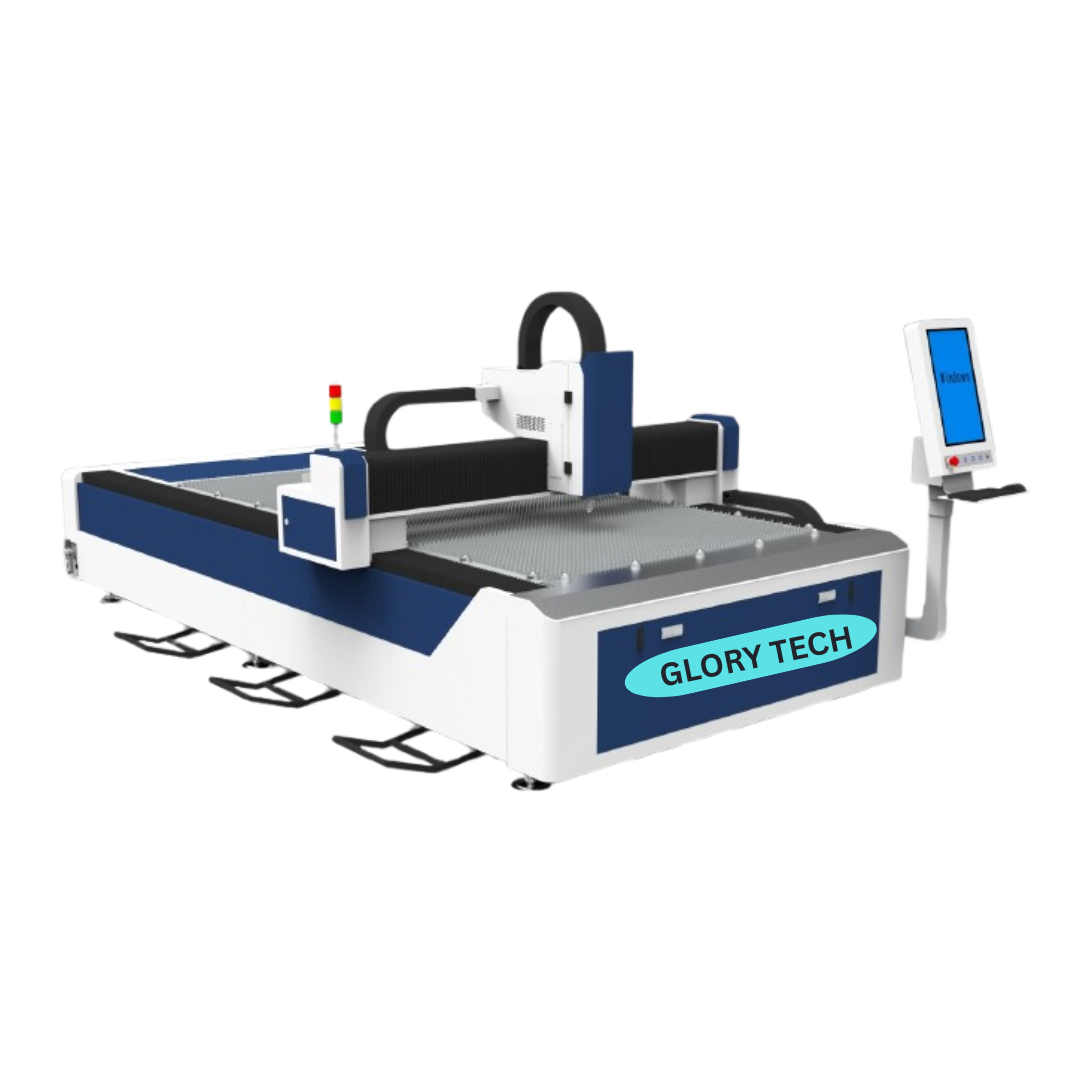
GT-3015
Fiber Laser Source
The core of the machine, producing a high-power laser beam. Popular brands include IPG, Raycus, MAX, and nLIGHT.
Cutting Head
Focuses the laser beam precisely on the metal surface. Often equipped with auto-focus for different material thicknesses.
CNC Control System
Controls cutting paths, speed, and parameters using CAD/CAM software.
Machine Bed / Frame
A rigid structure designed to minimize vibration and ensure cutting accuracy.
Motion System
Includes servo motors, linear guides, and rack-and-pinion drives for smooth and precise movement.
Cooling System (Chiller)
Maintains stable operating temperature for the laser source and cutting head.
Assist Gas System
Supplies oxygen, nitrogen, or compressed air to improve cut quality.
Fiber laser cutting machines are suitable for a wide range of metals, including:
Carbon steel
Stainless steel
Aluminum and aluminum alloys
Brass
Copper
Galvanized steel
Titanium
High Precision and Accuracy
Tolerances can reach ±0.02 mm, ideal for fine and complex designs.
High Cutting Speed
Faster than CO₂ lasers, especially for thin and medium-thickness metals.
Low Operating Cost
High electrical efficiency (up to 30–40%) and minimal maintenance.
Long Service Life
Fiber laser sources typically last over 100,000 hours.
Automation Ready
Can be integrated with automatic loading/unloading systems. Power Range and Cutting Capacity
Fiber laser machines are available in various power levels:
1 kW – 3 kW: Thin sheet metal cutting
4 kW – 6 kW: Medium thickness industrial applications
8 kW – 20 kW+: Thick plate cutting and heavy-duty manufacturing
Higher power allows faster cutting and thicker materials but increases cost.
Fiber laser metal cutting machines are widely used in:
Automotive manufacturing
Aerospace industry
Electrical cabinets and enclosures
Metal furniture and kitchen equipment
Construction and structural fabrication
Advertising and decorative metalwork
No physical tool contact (no tool wear)
Narrow kerf and minimal material waste
Smooth edges with little or no secondary processing
Environmentally friendly with reduced noise and emissions

Lorem ipsum dolor sit amet, consectetur adipiscing elit, sed do eiusmod tempor...

Lorem ipsum dolor sit amet, consectetur adipiscing elit, sed do eiusmod tempor...

Lorem ipsum dolor sit amet, consectetur adipiscing elit, sed do eiusmod tempor...