
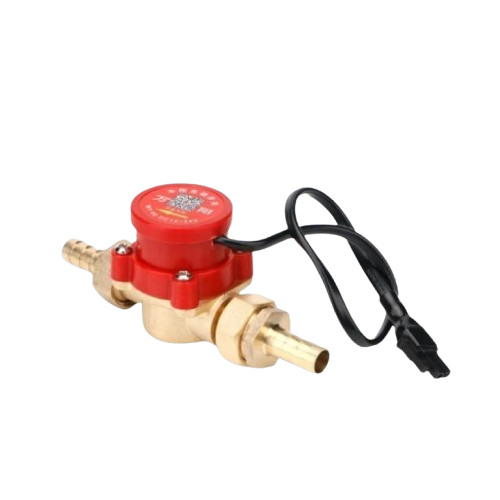

Product Category: Accessories All
Product Sub Category: All Accessories
Product Brand: Glory Tech Laser
Metal
A water flow sensor works by detecting the speed or volume of water flow through a pipe. Most commonly, it contains a rotor or turbine that spins when water flows. A Hall-effect sensor detects this rotation and generates pulses. The pulse frequency is proportional to the water flow rate, which is then calculated by a controller or microprocessor.
Sensor Body: Houses internal components and connects to the pipeline
Turbine/Impeller: Rotates with water flow
Hall Effect Sensor: Converts rotation into electrical pulses
Magnet: Attached to the turbine for signal detection
Signal Output Wire: Sends data to control systems
Seals and O-rings: Prevent leakage
a) Turbine Flow Sensor
Most common type
Suitable for clean water
Provides accurate flow measurement
b) Paddle Wheel Flow Sensor
Used in larger pipes
Good for moderate flow rates
c) Ultrasonic Flow Sensor
Non-contact type
No moving parts
Ideal for clean and dirty water
d) Electromagnetic Flow Sensor
Measures flow using magnetic fields
Suitable for conductive liquids
e) Mechanical Flow Sensor
Simple design
Used in low-cost applications
Plastic (ABS, Nylon): Domestic and light industrial use
Brass: Durable and corrosion-resistant
Stainless Steel: High-pressure and industrial environments
Accurate real-time flow measurement
Compact and lightweight design
Low power consumption
Easy installation and maintenance
Wide flow range compatibility
Digital or analog output options
Pulse Output: Common in microcontroller-based systems
Analog Output (4–20 mA / 0–5V): Used in industrial automation
Digital Communication (I²C, RS485): Advanced monitoring systems
Water purifiers and RO systems
Smart water meters
Industrial water management
Agricultural irrigation systems
HVAC systems
Coffee machines and dispensers
Fire protection systems
Helps monitor and control water usage
Prevents dry running of pumps
Improves system efficiency
Enables automation and smart control
Reduces water wastage
Install in the correct flow direction
Avoid air bubbles in the pipeline
Maintain straight pipe length before and after sensor
Ensure proper electrical grounding
Regular cleaning prevents blockage from debris or scale. Periodic calibration ensures accurate measurements, especially in industrial applications.
A water flow sensor is a vital component for accurate flow measurement and efficient water management. Its versatility, reliability, and compatibility with modern control systems make it essential in both domestic and industrial applications.

Lorem ipsum dolor sit amet, consectetur adipiscing elit, sed do eiusmod tempor...

Lorem ipsum dolor sit amet, consectetur adipiscing elit, sed do eiusmod tempor...

Lorem ipsum dolor sit amet, consectetur adipiscing elit, sed do eiusmod tempor...