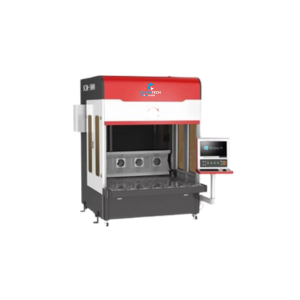

Product Category: Fiber Laser
Product Sub Category: Fibar Laser Metal Cutting
Product Brand: Glory Tech Laser
Two fast-rotating mirrors (X and Y axes) that steer the laser beam across the surface at very high speeds.
A third control mechanism (either motorized optics or dynamic lens) adjusts focus on the Z-axis during marking.
This enables focus tracking along complex shapes without moving the workpiece.
Can be CO₂ lasers (typically 10.6 μm wavelength for organic/non-metal materials) or fiber/MOPA fiber lasers (around 1064 nm for metals and mixed materials).
Power options vary widely depending on application — from tens of watts to hundreds of watts.
Auto-focus optics that dynamically adjust focal depth in sync with the galvo scanning system — thus enabling true 3D marking on uneven surfaces.
Software like EZCAD3 controls scanning patterns, power, speed, and focal adjustments.
Supports multiple file formats such as AI, DXF, PLT, BMP, and 3D STL for complex surfaces.
Systems often include air or water cooling to maintain thermal stability for the laser source and electronics.
Design Import: User uploads a design (text, vector, 3D STL, etc.) into the control software.
Laser Generation: The laser source emits pulses at controlled power and frequency.
Beam Steering: The galvo mirrors scan the laser beam across the workpiece surface at high speed.
Dynamic Focus: The system continuously adjusts focal depth (Z-axis) so the laser stays sharp over uneven/curved surfaces.
Marking/Engraving: The laser’s energy modifies the surface (carbonization, ablation, engraving) leaving a permanent, high-contrast mark.
Galvo scanning achieves very fast marking speeds (several thousand mm/s), far quicker than mechanical CNC systems.
Dynamic focusing keeps the laser spot tightly focused across the scanning area, enabling fine details, small fonts, and complex shapes.
Unlike traditional flat-field lasers, these machines can mark curved, tilted, or irregular surfaces without special fixturing.
Because scanning happens optically (without moving the workpiece), large fields can be covered with minimal mechanical wear.
Different laser types allow marking on materials including metals, plastics, wood, leather, ceramics, glass, textiles, and more.
✅ Industrial product marking (serial numbers, QR/barcodes, logos)
✅ Automotive components
✅ Electronics and precision parts
✅ Jewelry and custom engraving
✅ Textile and denim pattern marking (e.g., jeans processing)
✅ Packaging and advertising
✅ Medical and aerospace parts

Lorem ipsum dolor sit amet, consectetur adipiscing elit, sed do eiusmod tempor...

Lorem ipsum dolor sit amet, consectetur adipiscing elit, sed do eiusmod tempor...

Lorem ipsum dolor sit amet, consectetur adipiscing elit, sed do eiusmod tempor...